

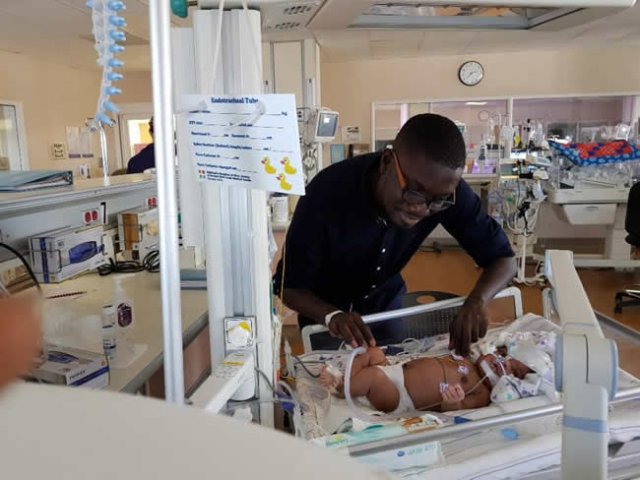
Some new parents shed tears of joy when their newborns arrive; however, in the case of Ameyaw Debrah, the tears he shed when he first saw his son were not out of joy.
The celebrity blogger and freelance journalist broke down and shed tears after seeing his son with different tubes attached to different parts of his body, lying in a machine that shook him up frequently.
Like most new fathers, he was excited when he was informed of the birth of his son and couldn’t wait to meet him and his then fiancée (now his wife), only to be taken to the Neeonatal Intensive Care Unit (NICU) where his son had been rushed to quickly after birth.
Ameyaw recounts that although he had heard of NICU, he didn’t know much about what happened there or what it meant to have a child at the unit.
Prior to meeting his son, his mother-in-law had informed him that his fiancée had gone through a difficult labour and that the baby had been taken to the unit, but she did not disclose the severity of his condition.
Meconium aspiration syndrome
The baby was diagnosed of Meconium Aspiration Syndrome (MAS) — a condition that affects newborns. It occurs when a newborn breathes meconium (dark green faecal material produced in the intestines of a foetus before birth) and amniotic fluid (a clear, slightly yellowish liquid that surrounds the unborn baby during pregnancy) mixture into his/her lungs shortly before, during or right after birth.
Ameyaw’s son had inhaled meconium which had blocked his airways.
“I was on my way to the hospital when my mother-in-law called to inform me about the birth of my son, and although I felt bad that I had missed the moment he was born, I was so excited and couldn’t wait to meet him. When I got to the hospital, I realised all was not well as my wife was crying. She said they had come to inform her that the baby was in a critical condition and they had started a treatment plan for him,” he said.
In his case, his wife could not move to the NICU immediately as she had just been through a caesarean section and so he had to go to the facility first and what he saw there completely broke him.
“I went to the hospital with some expectations and I think the contrast between my expectations and what I saw there was what made me cry. There he was, lying down helplessly with so many tubes connected to his small body. And him in the unit were other babies, some very tiny in different conditions,” he said.
Baby is referred to a specialist hospital
According to him, although the doctors gave him all the information he needed, he panicked when the baby had to be moved to a specialist hospital two days later as that facility did not have the machines needed for his son’s treatment.
“My wife had completely broken down by then and I was also scared but I had to be strong and give her all the support she needed. Moving the baby meant his condition wasn’t getting better and that is definetly not good news for any parent.
“The hospital made arrangements and baby was moved to the referral facility for further treatment and even there, the doctors discussed the possibility of trying a more advanced treatment method if he didn’t recover as they expected,” he added.
The medical team considered using the Extra Corporeal Membrane Oxygenation (ECMO) machine. The machine is similar to the heart-lung by-pass machine used in open-heart surgery. It pumps and oxygenates a patient’s blood outside the body, allowing the heart and lungs to rest. When you are connected to an ECMO, blood flows through tubing to an artificial lung in the machine that adds oxygen and takes out carbon dioxide; then the blood is warmed to body temperature and pumped back into your body.
Thankfully, the baby’s condition improved without the assistance of the ECMO machine.
Stressful experience
Ameyaw’s wife delivered at the University Hospital and baby was later referred to the Beth Israel Hospital, both in New Jersey, United States of America. Both facilities had advanced equipment compared to what is available here in Ghana, and although he had hope that baby could receive the best of care and recover completely, he admitted that the NICU experience was a stressful one.
The baby was put on antibiotics and other drugs and was on oxygen and required many laboratory tests for doctors to track his progress.
Sadly, Ameyaw had to leave the US for Ghana as he had other commitments and depended on feedback from his wife who was then strong to provide feedback on the progress of his baby.
He also requested that the hospital send him daily updates on baby’s progress through email, which it did.
“The good thing is that before I came to Ghana, he was recovering and I could put my finger in his palm and touch him, unlike the weeks before when all I could do was watch him lie on the ventilator,” he recalled.

After over a month at the facility, exactly on Christmas Eve, Ameyaw’s son was discharged from the hospital, just in time for Christmas.
“We kept praying that he would at least be home by Christmas and thankfully, our prayers were answered.”
He also added that the cost for treatment was very expensive but thankfully, they had an insurance policy that covered the cost.
To fathers with babies in NICUs currently, he advised, “The NICU is a difficult place to be but stay calm, be there for your partner and speak to the health experts. Many babies have survived serious complications so be comforted by these success stories and keep praying. My son would be four in November and it’s amazing when I look at him jump around and scattering things around. He is a very strong and active boy.”
Ameyaw’s story is part of the stories we are sharing this month as we celebrate fathers who have been in NICUs