

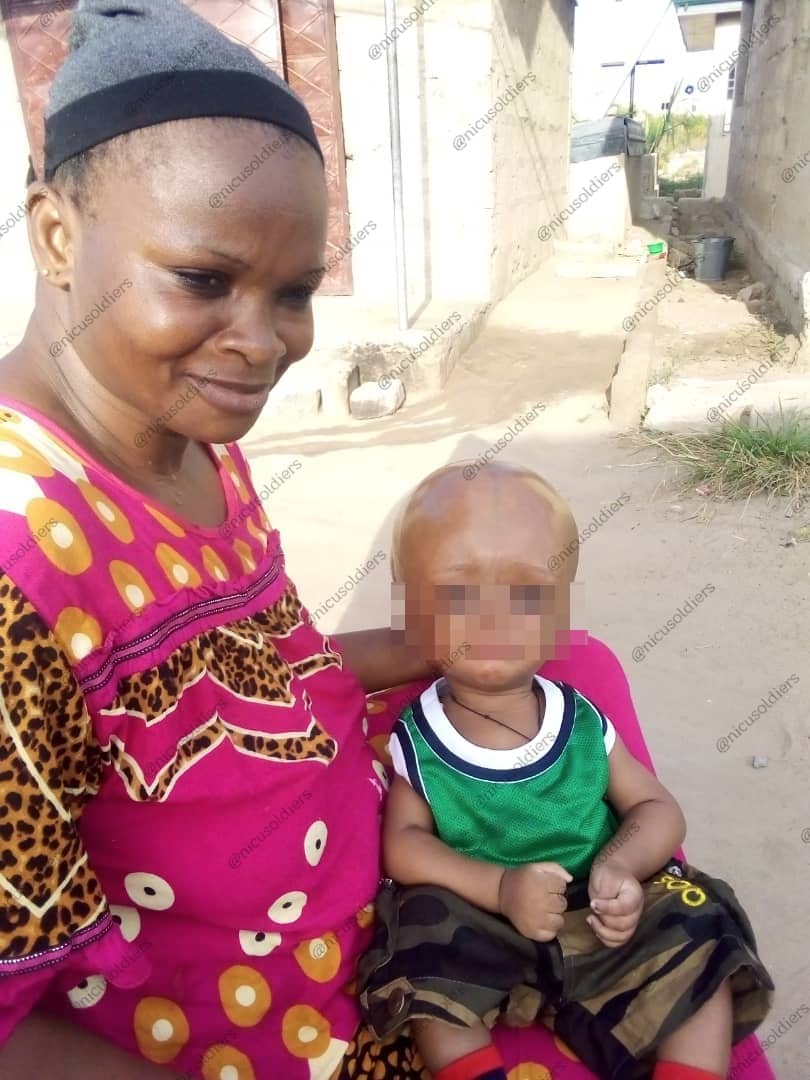
Some babies who go to the Neonatal Intensive Care Unit (NICU) recover completely or are discharged when their conditions improve, but for others and their parents, the unit is the beginning of a long hospital journey.
Rubatu Taju and her son, Shaban Tajudeen, fall within the second category as they have lived in the hospital for several months even after being discharged from the NICU.
They stayed in the NICU for five weeks, the Emergency Room (ER) for four days, the baby’s ward for close to four months and the Neurosurgery Unit for nine days after baby’s first surgery and two months after the second and third surgeries.
These hospital stays exclude review days and visits to scan, laboratory and other diagnostic health centres.
Since Baby Shaban was born 10 months ago, his mother can count the number of weeks she has stayed at home with her baby as most of their time is spent in the hospital or soliciting for funds for treatment.
Rubatu was not new to motherhood and had a fairly smooth pregnancy till a scan at 31 weeks pregnant indicated fluid in the head of her baby (hydrocephalus).
Her local antenatal clinic immediately referred her to a bigger facility to see a specialist and she was eventually referred to the Korle Bu Teaching Hospital in Accra.
She recounts that when she arrived at the hospital, the team treated her case as an emergency and arranged for a caesarian section to save her baby’s life.
NICU shock
She understood that her baby would need some medical assistance after delivery but didn’t know the severity of his health condition till she first saw him at the NICU.
“He was lying under a blue light and we were asked to run several lab tests. Almost everyday, there was a lab test to run and I could see his head was bigger than usual. Anytime I visited, I could see doctors by his cot, discussing his condition and going through his files,” she recounted.
Rubatu said five weeks after her baby was born, he was discharged from the NICU but was asked to report to the Neurosurgery Unit of the hospital for an invoice of the cost for surgery to correct her son’s condition.
“Apart from his head, I also realised there was a growth at his back and one of the doctors explained that they would have to do a surgery to correct that as well. I was directed to the account unit for the invoice and given a date to report for the surgery,” she narrated.
Financial challenges
Rubatu, a petty trader, and her husband, an okada (commercial motorbike) rider, had spent most of their savings on drugs, scans and laboratory tests and had difficulty raising the GH¢12,603.24 needed for the corrective surgeries.
In the early days, some family members and close relatives promised to support the operation but recoiled when the time for surgery was drawing near.
Even her husband who had supported her during pregnancy and at NICU gave up and showed little interest in raising the money for the operation.
“Some of his relatives told him the baby would not survive so there was no need spending money and time on him. Others said he was cursed and suggested we abandon him at the hospital.

“I rejected these opinions although I knew it wouldn’t be easy raising the amount needed. How could I leave my son at the hospital because he had a deformity? How would I sleep knowing I had abandoned a baby I had carried in my womb for nine months? Even if he was a baby I had seen on the streets, I would have nursed him till his parents or the appropriate authorities came for him. I am not heartless!” she said.
Unable to raise money
The date for the review passed and she had still not been able to raise the amount needed.
She reached out to a number of media houses for assistance but did not get any positive results, so she decided to visit some known philanthropists for assistance.

“On such visits, I had to take my son along so the people could confirm his situation. I was told many people forged such stories and presented fake documents to raise money so I had to go with him. One day we visited a very popular politician but we were told by the security officer to come the following day as he was not available.
“We live quite far from town and I couldn’t afford to go home and return the following morning so I slept in an abandoned building with my baby and one of my older children till the following morning.
“Unfortunately, the next day, we were told the man couldn’t come to the facility and we had to go home,” she said.
Condition deteriorating
Fed up with running around begging for money which usually ended with “oh we are sorry” or “come another day”, Rubatu had no option than to report to the hospital with half the amount she had raised from collecting small loans from friends and selling her personal belongings.
When she finally reported to the Neurosurgery Unit, her baby had severe fever and was sent to the emergency ward of the Child Health Department for treatment.
The visit to the ER which she thought was for a couple of days turned into rotating between sitting in a plastic chair and sleeping on the floor for close to four months.
Baby Tajudeen’s condition had deteriorated into an infection which needed to be treated before the surgery could be done. All the money she had raised went into buying antibiotics and other drugs to stabilise her son.
She also had to run several laboratory tests and scans.
“The medicines are expensive and so we are always looking for money. Meronen costs GH¢350 and lasts for just a day, and he was on it for over 20 days. At a point, I couldn’t afford that so they had to prescribe a cheaper option but his condition wasn’t getting any better so we came back to using Meronen.
“It has not been an easy journey for me, my baby and my children at home. I hardly stay at home and my young children have to fend for themselves or depend on some neighbours as their father’s attitude has changed. He hardly pays any attention to them.
“Some people I met at the hospital who were touched by my plight linked me to different people who have supported me financially till date. There are people who started supporting me but realised our bills were too much and so couldn’t continue.
“I am extremely grateful to anyone who has supported us; the list is endless. I know there are good people in this world. Most of my family members have dejected me because of my son’s condition but strangers have shown me so much love, and for that, I am eternally grateful,” she said, trying to hold back her tears.
Three surgeries and more to go
In the last three months, baby Shaban has undergone three major surgeries in the head and has been discharged to report after a month for doctors to access him and know the way forward.

The 10-month-old can not sit, move or play like other babies his age, and his mother, a warrior parent, is determined to go every length to see her son get better.
“The units (babies and neurosurgery) have no beds for mothers and so at night I put a cloth on the floor and sleep. I have constant back pain and sometimes feel pains from my CS wounds but I can’t complain because I have to be there for my son always.
“I was in the hospital throughout the COVID-19 peak period and there are days when I completely break down, but I know Allah will see us through,” she said.
Editor’s note updated: Rubatu’s husband was reported to the Domestic Violence and Victim Support Unit (DOVVSU) at Nyanyanor, near Kasoa for neglecting his wife and son.
Unfortunately, after three major surgeries, baby Shaban passed at home recently.
I wish to express my sincere gratitude to the MTN Ghana Foundation for footing the cost of surgeries for Baby Shaban.
I am also grateful to everyone who shared her story, contributed and to the nurses and doctors at the NICU, Baby’s Unit and Surgical Department of the Korle Bu Teaching Hospital.
kindly keep Rubatu in your prayers.